
Qest or (Quest) pipe in your DFW home? Here’s what you need to know (and why you’ll probably have to replace it).
Qest is a polybutylene pipe installed in millions of homes from 1978 to 1995. It gets brittle with age, its fittings shear, and there is no spot repair. Here is how to identify it, why it fails, and what replacement actually costs in North Texas.

Updated May 2026
Your plumber just told you that you have Qest pipe. Or maybe you noticed a leak at your water meter and called someone out to take a look. Either way, you want a straight answer about what Qest pipe is, whether it’s actually a problem, and what it’s going to cost to fix.
Here’s the short version: Qest is a brand of polybutylene pipe installed in millions of homes between 1978 and 1995. It gets brittle with age, its fittings shear and fail, and there is no spot repair. When Qest fails, the entire line has to be replaced. In the DFW area, most Qest pipe is the water service line running from your city meter to the house, what local plumbers call “Big Blue.”
What is Qest pipe?
Qest (properly spelled “Qest”) was the most popular brand of polybutylene (PB) plumbing pipe sold in the United States. It was manufactured by United States Brass Corporation using polybutylene resin from Shell Oil Company. The pipe is a flexible plastic made from polymerizing 1-butene, a byproduct of oil refining.
At peak popularity in the mid-1980s, polybutylene was going into roughly one out of every four new American homes. An estimated 6 to 10 million homes were built with it nationwide. Builders loved it because it cost a fraction of copper, installed fast, and required no soldering.
In the DFW area, Qest pipe was used primarily as the water service line running from the city water meter to the house connection. That’s the line most local plumbers call “Big Blue” because of its distinctive blue color. It’s typically one-inch diameter Qest pipe buried in the front yard. Some older mobile homes in the area also have Qest pipe running underneath the structure.
“We call it Big Blue. It’s gonna be your water service line. Just a big one-inch Qest line that fails all the time.”
Ray DavisLicensed Master Plumber, Christmas Air
In other parts of the country (Virginia, the Carolinas, Florida), Qest was also used for interior plumbing throughout the house, running to every fixture. Ray confirms that in DFW he has not seen Qest used through the interior of homes, only as the yard service line and in some mobile home applications. That said, if your home was built during the Qest era, it’s worth checking under sinks and behind toilets to be sure.
Why Qest pipe fails
Qest pipe has two separate problems. The pipe material itself becomes brittle with age. And the fittings it was sold with were defective.
The pipe gets brittle
Polybutylene reacts with chloramine, the disinfectant used by every major water provider in the DFW area. Over time, chloramine strips the antioxidant stabilizers out of the pipe wall. Once those are gone, the inner surface starts to degrade. The pipe becomes chalky and fragile. Because the damage happens from the inside out, the exterior can look perfectly normal while the interior is falling apart.
Every major DFW water provider uses chloramine. The North Texas Municipal Water District serves over 2 million people across Plano, Frisco, Allen, McKinney, Carrollton, and The Colony. The Upper Trinity Regional Water District serves Flower Mound, plumber in Lewisville, Highland Village, Corinth, Argyle, and Little Elm. Both use chloramine as their primary disinfectant. So does the City of Dallas. There is no safe zone in the metroplex for Qest pipe.
The fittings shear
Qest pipe was sold with brass fittings that were prone to shearing. At the connection point where the Qest line meets the city infrastructure, DFW plumbers commonly find “flow lock” fittings, PVC compression fittings that connect to the water meter. The Qest pipe shears right at that fitting. That meter connection is the single most common failure point.
“They had brass fittings, and the fittings were actually shearing. Typically right at the junction point, right at the meter. They use what they call flow lock fittings, which is a PVC fitting that acts as compression. And the Qest will actually shear right at that fitting.”
Ray Davison the most common Qest failure point
The false-hope problem: why a small leak is not a small fix
Here’s where homeowners get caught off guard. A leak shows up at the water meter. It’s right there at the surface, easy to see. The natural assumption is that it’s a simple, inexpensive repair: dig up a small section, fix the connection, done.
That’s not how Qest works.
Because the pipe is brittle throughout its length, cutting into it to make a spot repair can cause damage further down the line. And even if you could repair one section, the rest of the pipe is the same age, exposed to the same water chemistry, and in the same condition. A spot repair on Qest is not a fix. It’s a temporary patch on a system that’s failing everywhere at once.
“Customers, nine times out of ten, they’re gonna see the pipe and say, ‘It’s just leaking right here. We gotta dig up just this much and make a repair.’ What they don’t realize is that the Qest line, we can’t tap into anymore. This is gonna be an entire yard service that has to be replaced.”
Ray DavisLicensed Master Plumber, Christmas Air
This is one of the few things nearly all plumbers agree on. You’re not going to find a reputable plumber who will do a spot repair on Qest pipe. Some cities in the DFW area don’t even allow spot repairs on Qest anymore. The liability is too high. The only correct repair is a full replacement from the meter to the house.
Think you might have Qest pipe? Get a straight answer in one visit.
Call or text Christmas Air. We’ll check your water service line, identify the pipe material, and tell you exactly what you’re dealing with, with no pressure and no upsell.
How to tell if you have Qest pipe
Start at your water meter in the front yard. If you can see the pipe where it connects to the meter, you’re looking for a flexible plastic pipe, typically blue (that’s “Big Blue”), about one inch in diameter. It feels distinctly different from rigid PVC or copper.
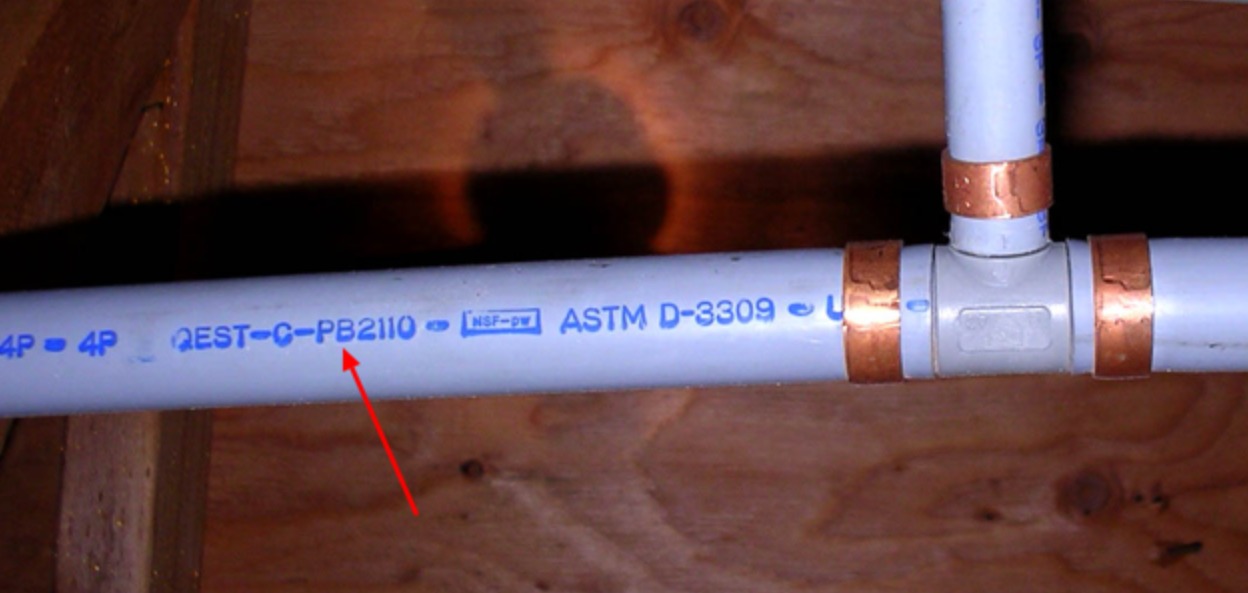
The definitive identifier is the stamp printed along the pipe. Look for one of these markings:
- ✓PB2110 — the material code used exclusively for polybutylene
- ✓ASTM D3309 — the standard that applies only to PB pipe
- ✓“Qest” or “Quest” — the brand name itself
- ✓Soft, flexible feel — noticeably softer and thinner-walled than PEX
These markings repeat about every 5 feet along the pipe. If you only have a short section exposed, you may need to expose more pipe to find them.
“Pretty much the only mistake homeowners make is they think they have PEX and it’s not PEX, it’s Qest. That’s when I explain the difference. I’ll cut a piece of PEX and show them the difference between the two. They can just tell how much harder PEX is compared to Qest. Qest is very soft.”
Ray Davison why homeowners mistake Qest for PEX
Do not confuse Qest with PEX
PEX is typically color-coded red (hot) and blue (cold) or is white. PEX has different ASTM markings (F876/F877) and will never show “PB2110” or “D3309.” PEX is cross-linked polyethylene, a much stronger, completely different material. Qest is polybutylene. They are two different chemicals with very different track records.
If your home was built between 1978 and 1995 and you have not had the water service line replaced, you should check. If your home was not disclosed as having Qest pipe when you bought it, you may not know until a problem appears.
The class action lawsuits (and why they can’t help you now)
Qest pipe produced two of the largest product liability settlements in American history.
Cox v. Shell Oil
$1.14 billion
Repiped more than 320,000 homes. Claims were processed through the Consumer Plumbing Recovery Center, located in Plano, Texas. The Cox claims deadline passed around 2009.
Spencer v. Shell Oil
$120 million
Added another $120 million to the recovery fund. A 2017 attempt to revive the litigation was dismissed permanently. Over 600,000 consumers filed claims, but only 320,000 homes were repiped.
Both settlements are closed. If you still have Qest pipe, the replacement cost is on you.
What Qest pipe means for your insurance and home value
Most major Texas homeowners insurers now refuse to write policies on homes with known polybutylene, exclude water damage from coverage, or impose damage caps as low as $10,000. Premium surcharges of $5,000 to $7,000 per year have been documented. In many cases, the annual surcharge alone exceeds the cost of a full water service replacement.
No homeowners insurance policy covers the cost of replacing the pipe itself. Insurance may cover resulting water damage from a sudden leak (if water damage is not excluded), but the pipe replacement is always out of pocket.
What it does to your home’s value
On the real estate side, homes with Qest pipe typically sell for $10,000 to $20,000 less than comparable homes with updated plumbing. Home inspectors in DFW routinely flag it as a material defect. Texas law requires sellers to disclose known plumbing defects on the TREC Seller’s Disclosure Notice. If you know your home has Qest pipe and don’t disclose it, you’re exposed to a misrepresentation claim.
VA loans appear to have the strictest lending requirements around polybutylene. FHA loans require the plumbing system to be intact and functional but don’t specifically ban PB. Conventional lenders have no blanket prohibition, but if the buyer can’t get insurance because of the pipe, the financing falls apart.
What replacement looks like, and what it costs in DFW
For DFW homes, Qest pipe replacement is typically a water service line job: replacing the pipe from the city meter to the house connection. Here’s how the process works, step by step.
Your plumber arrives, confirms it’s Qest, and measures the front yard from meter to house. The plumbing company contacts an excavation crew, which typically comes out the next day. For a run of 30 feet or less, the trench is dug and the new pipe installed in the same day. Longer runs may take one day for digging and a couple of hours the next day for the plumbing work.
Permits are required for water service lines. Because an active leak is considered an emergency, your plumber can start work immediately and has 72 hours to file the permit after the job is complete. Once the new line is in place, the office calls for a city inspection. The inspector checks the line and verifies water pressure is below 80 PSI. Inspections typically happen the next business day. After a passing inspection, the excavation crew returns to backfill the trench.
Total timeline from approval to close-out: 3 to 5 business days for a typical residential water service.
What it costs
PEX-A is the recommended replacement material. It’s cross-linked polyethylene, a much stronger pipe than the polybutylene it replaces. It handles freeze events better than copper (critical after the 2021 Texas winter storm), resists DFW’s hard water, and costs significantly less than copper. Because roughly 90 percent of DFW homes sit on slab foundations, plumbers run the new service line through the trench and connect at both ends without disturbing the slab.
The math favors replacing it now
Here is the simple cost-benefit picture:
- ✓One replacement costs $2,500 to $6,500. Once.
- ✓Insurance surcharges on a polybutylene home can run $5,000 to $7,000 per year. Every year.
- ✓A catastrophic failure can cause $50,000 or more in water damage plus mold remediation.
- ✓Homes with updated plumbing sell for $10,000 to $20,000 more than comparable homes with Qest pipe still in the ground.
Replace it before it fails. Every year you wait increases the risk and adds another year of inflated insurance premiums.
Northern DFW neighborhoods where we see Qest pipe
Any home built between 1978 and 1995 in the DFW suburbs should be considered at risk. Here’s what we know from our field experience and local development timelines.
This list is not exhaustive. If your home was built by a production builder during these years anywhere in the DFW area, check your water service line.
Frequently asked questions
Can I just repair the spot where it’s leaking?
No. Qest pipe gets brittle with age throughout its entire length. Cutting into it to make a spot repair can cause damage further down the line. The only correct repair is a full replacement from the meter to the house. Most reputable plumbers will not do spot repairs on Qest, and some DFW cities no longer allow them.
My Qest pipe hasn’t leaked in 30 years. Do I still need to replace it?
Yes. The pipe degrades from the inside out. The exterior can look normal while the interior is breaking down. The absence of a leak does not mean the pipe is healthy, it means the failure hasn’t broken through yet. These systems are now 30 to 47 years old, well past their expected lifespan.
Will my homeowners insurance cover replacement?
No. Insurance does not cover pipe replacement as a maintenance expense. It may cover resulting water damage from a sudden leak, but many Texas insurers now exclude or cap water damage on homes with polybutylene. The pipe replacement is always out of pocket.
How do I know if I have Qest pipe if I can’t see it?
Look at the pipe where it connects to your water meter in the front yard. If you see blue, flexible plastic pipe about one inch in diameter, that’s likely Qest (“Big Blue”). The stamps on the pipe, repeating about every 5 feet, will confirm it: look for “PB2110” or “ASTM D3309.” If you’re not sure, a plumber can confirm it in a single visit.
Is Qest pipe the same thing as PEX?
No. Homeowners confuse them because both are flexible plastic, but they are completely different materials. Qest is polybutylene. PEX is cross-linked polyethylene, a much harder, much stronger pipe. If your plumber holds a piece of each, you can feel the difference. PEX is the current industry standard. Qest has been off the market since 1996.
Does Qest pipe affect my ability to sell my home?
Yes. It reduces your home’s value, triggers inspection flags, can prevent buyer financing if insurance can’t be obtained, and creates disclosure obligations under Texas law. Replacing the water service line before listing eliminates all of these problems and typically returns more than the cost of replacement in sale price.
Need a Qest pipe inspection or water service replacement in DFW?
Christmas Air Conditioning & Plumbing serves Flower Mound, Lewisville, Argyle, plumber in Denton, and the surrounding DFW area. Veteran-owned. Straight answers.