
Drain cleaning guide
Hydro Jetting vs. Drain Snaking: Which Does Your DFW Home Need?
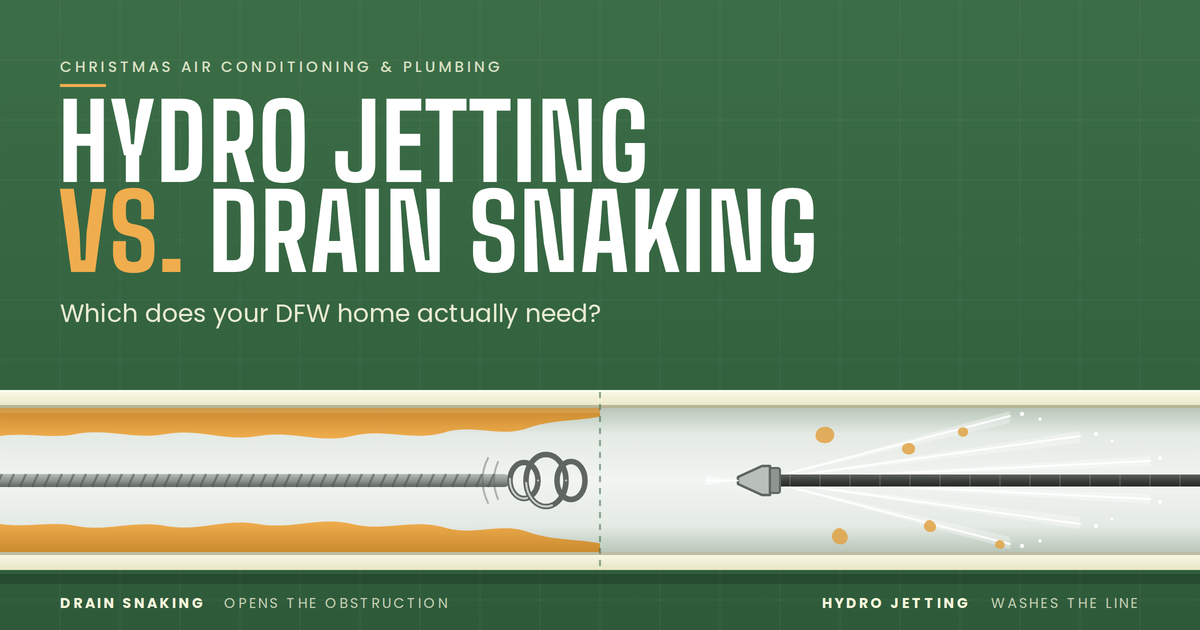
A drain snake sends a rotating cable and a chosen tool down the line to reach, probe, break up, cut, or pull back the obstruction. Hydro jetting pushes water through a hose and nozzle to loosen deposits and scrub the pipe wall as the hose comes back out. The right method depends on what’s blocking the line and whether the pipe can be cleaned safely.
That’s the comparison. The harder question is which situation you’re actually in, and that deserves a few minutes before anyone picks a tool.
Not sure which one your line needs? Start with a diagnosis.
Christmas Air Conditioning & Plumbing handles drain diagnosis, cable cleaning, and hydro jetting for homes across Dallas-Fort Worth. Book online or reach a real person, 7 days a week, 8:00 a.m.-6:00 p.m.
The short answer: snaking opens the obstruction; jetting washes the line
Snaking is mechanical. A cable spins inside the pipe, and whatever head is on the end does the work, pushing through, cutting, or hooking the blockage so it can be pulled back. Jetting is hydraulic. Water does the work, both to move the hose forward and to strip material off the pipe wall on the way back. Neither is better as a rule. Each fits certain obstructions and certain pipes.
Which one fits your line depends on what the obstruction is, where the technician can get into the pipe, the pipe’s diameter and material, how it’s holding up structurally, what’s happened in that line before, and what the technician can actually observe. Some of that is knowable from the driveway. Some of it isn’t, which is why a professional drain cleaning and clog removal visit usually starts with questions rather than equipment.
| Factor | Drain snaking | Hydro jetting |
|---|---|---|
| Equipment | A drain-cleaning machine that drives a rotating cable fitted with a selected head or tool | A water jetter that pushes water through a flexible hose and a nozzle |
| Action in the pipe | The cable turns and the tool probes, breaks up, cuts, or retrieves the obstruction | Rear-facing jets pull the hose forward, then scrub the wall and flush material as the hose is retrieved |
| Problems it may address | Localized clogs, hair and fibrous wads, objects that can be broken up or pulled out | Grease, sludge, soap film, sediment, and some root intrusion when the pipe allows it |
| Main limitation | Can restore flow without removing soft buildup that coats the pipe wall | Water pressure can damage a weakened or already compromised line if misapplied |
| Condition check | Pipe size, access point, and what the cable can reach | Pipe material, structural condition, access, and the right nozzle and pressure for that line |
How drain snaking works
A cable machine feeds a rotating steel cable into the drain through a cleanout, a fixture opening, or a pulled trap, with a head on the end chosen for the job. The operator manual for RIDGID’s K-45 drain cleaning machine, a compact unit made for secondary lines like sinks and tubs, describes selecting the cable and tool for the job and using the cable to probe an obstruction and retrieve material. That’s one machine, not an industry rule, but the logic carries: the head gets picked once the obstruction is understood.
Tool choice changes what the cable does. A bulb or straight auger can probe an obstruction and bring material back out. Cutting heads exist for tougher material. Different cables suit different pipe diameters, and a small sink machine isn’t the same tool as a main-line machine. One cable, one head, and one pipe size don’t cover every clog.
Where snaking tends to be the first consideration: a single fixture that stopped suddenly, hair and fibrous material near a tub or shower drain, an object that can be broken up or retrieved, or a first-line attempt where the likely cause is reasonably clear. It’s quick to set up and it doesn’t put water pressure on the pipe.
Its limit is the thing people notice weeks later. A cable can restore flow through a greasy kitchen line and leave most of the film on the pipe wall, because the tool passed through the middle of the buildup rather than scrubbing the edges. That’s not a failure of the technician. It’s a limit of the method for that particular deposit.
How hydro jetting works
A water jetter connects a pump to a flexible hose with a nozzle on the end. Rear-facing jets on the nozzle help move the hose forward through the drain, and the cleaning happens as the hose is pulled back, with the jets scrubbing the pipe wall and flushing loosened material downstream. RIDGID describes its KJ-3100 water jetter in those terms: water pressure and flow combine to clear sludge, soap, grease, and sediment, with the line scrubbed and flushed as the hose is retrieved. That’s one manufacturer’s description of one product, cited for how the mechanism works rather than as a claim about every jetter.
Municipal sewer specifications describe the same principle at a larger scale. One city’s preparatory sewer-cleaning specification calls for high-velocity cleaning equipment with a nozzle that scours the pipe wall, mechanical cleaning where the situation warrants it, and precautions against flooding and property damage. The homeowner takeaway isn’t the equipment list. It’s that professionals treat jetting as work that needs the right setup and safeguards, not a hose pointed down a drain.
Jetting comes up for grease, sludge, soap residue, sediment, and some root intrusion, when the pipe’s material and condition can handle it and there’s a usable access point. What makes the difference is the nozzle chosen, the pressure and flow the operator runs, where the hose enters the line, and what the pipe is made of and how it’s holding up. Guidance from the BPF Pipes Group on effective cleaning of drains and sewers treats pipe material, structural condition, workmanship, and pressure selection as central to cleaning a line without harming it, for jetting and for rotary and rodding methods alike.
You’ll see hydro jetting advertised as a full restoration of the pipe. Skip that claim. A jetter can remove buildup from a wall that’s structurally sound. It can’t repair a cracked joint, and no single pressure figure applies to every line. Christmas Air’s hydro jetting services page covers when the company considers water jetting for a residential line.
Which method fits the problem you are seeing?
Symptoms narrow the possibilities. They don’t prove what’s in the pipe. A slow tub usually means hair, and usually isn’t the same as certainly. Two bathrooms backing up at once points toward the main line, but the cause could be roots, a sagging section, or a wad of wipes, and each of those leads somewhere different.
Use the matrix below to find the pattern closest to yours. It’s built to show what the symptom may mean, the first question a technician should be asking, the method that may come up, and the point at which cleaning should pause for an inspection.
Show situations involving
Showing 7 of 7 situations.
| What you’re seeing | What it may mean | First diagnostic question | Method that may be considered | Why | When inspection is needed |
|---|---|---|---|---|---|
| One fixture stopped suddenly | A localized obstruction close to the fixture, often in the trap or the branch line. | Did anything go down that drain recently, and is every other fixture draining normally? | Cable machine, often a small-line cable with a probing or retrieving head. | The obstruction is likely reachable and mechanical, and water pressure isn’t needed to move it. | If the cable clears nothing, meets a hard stop, or the clog returns within weeks. |
| Hair or fibrous material near a tub or shower drain | A wad building on the stopper, in the trap, or just past it. | Did the drain slow gradually over months, or stop all at once? | Cable with a head that can hook and retrieve, or hand removal at the stopper. | Fibrous material catches on a retrieving tool more readily than it breaks down under water. | If the same drain keeps slowing after hair is cleared, or water backs up into another fixture. |
| Kitchen line that repeatedly slows with greasy residue | Grease and soap film coating the pipe wall rather than one plug in the middle. | How long does a snaking last before the drain slows again? | Water jetting, if access and pipe condition allow it. | A cable can open a channel through soft buildup and leave the film. Jetting is meant to scrub the wall. | Before jetting an older kitchen line, when material or condition is uncertain, or when buildup returns quickly regardless of method. |
| Several fixtures slow or backing up | Trouble downstream of the individual branches, possibly in the building drain or the sewer line. | Which fixtures are affected, and is the lowest one showing it first? | Neither yet. Locate the obstruction and assess the line first. | Main-line problems range from wipes to roots to structural failure, and each calls for different work. | Now. Multiple fixtures backing up is a diagnosis situation, not a sink clog. |
| The same line clogs again after prior cleaning | The earlier cleaning restored flow without removing the cause, or something structural is catching debris. | What was done last time, what was found, and how long did it hold? | Depends on the cause. Jetting for wall buildup, repair for a structural defect. | Repeating the same method on a repeating problem rarely changes the outcome. | Before any further cleaning. Repeat clogs are the strongest signal that the line needs a look. |
| Suspected roots or main-line trouble | Root intrusion at a joint or crack, or another defect that’s collecting debris. | Are there trees near the line, and has this happened before around the same time of year? | Root-cutting heads or jetting, only after the line’s condition is understood. | Roots mean an opening exists in the pipe. Cutting them restores flow but doesn’t close it. | Before cleaning where possible, and after cleaning to see what the roots came through. |
| Older, damaged, collapsed, offset, or unknown pipe | The pipe itself may be the problem, or may not tolerate aggressive cleaning. | What is the pipe made of, how old is it, and has it ever been inspected? | Nothing aggressive until condition is known. Repair may be the right answer instead of cleaning. | Jetting or heavy cabling a compromised line risks turning a clog into a broken pipe. | Before choosing any method. |
The last four rows are where fixture-level drain cleaning hands off to Christmas Air’s sewer line cleaning and repair work, because the question shifts from “what’s in the pipe” to “what shape is the pipe in.”
When pipe condition changes the answer
High-pressure water applied to a pipe that can’t take it can do real damage. Peer-reviewed research on high-pressure water jetting and avoiding damage to sewers examined how jetting harms drains and sewers under some conditions and why preventative operating guidance matters. That’s the reason a careful technician wants to know about the pipe before committing to a method, not just about the clog.
Things that raise the caution level, without being diagnoses: cracks, joints that have separated, a section that has collapsed or deformed, heavy corrosion or deterioration in metal pipe, and mixed materials of unknown age in one run. Established North Texas homes can have several pipe ages and materials under one roof, especially where additions or partial repairs happened over the years. None of that says your pipe is bad. It says the method shouldn’t be chosen blind.
Locating the obstruction and assessing the line can involve a sewer camera when it’s appropriate. A camera is useful, and it’s also limited. It can’t see through a line that’s completely blocked, and a lens coated in grease shows grease. Sometimes the line has to be cleaned partway before the camera gives a usable view, and in that order the cleaning is diagnostic as much as corrective. Don’t expect perfect footage on the first pass in every line.
Where the pipe turns out to be the problem, plumbing repair belongs in the conversation before any more cleaning does. For a plain-language rundown of what damage looks like from inside the house, Christmas Air’s guide to the signs of sewer-line damage covers the symptoms.
What a drain-cleaning visit should clarify
You don’t need to diagnose the pipe yourself. You do need to leave the visit knowing why one method was chosen over the other. These questions get you there.
- Which fixtures and lines are affected?
- Is this a one-time clog or a repeating pattern?
- What does the technician think the obstruction is, and what evidence supports that?
- What access point will be used?
- What is known about pipe material and condition?
- Is the goal to restore flow, remove wall buildup, inspect the line, or a combination?
- What would make the technician stop and recommend repair instead of more cleaning?
If the answer to the second question is “repeating pattern,” ask for a drain maintenance conversation rather than another one-off clearing. Christmas Air’s piece on sewer backup causes and prevention explains why backups tend to repeat when the underlying cause is left alone.
What not to do while choosing a method
- Don’t mix chemical cleaners or keep adding product. A blocked line holds whatever went into it, and the next person to open that trap is standing over it. Tell the plumber what’s already been poured in.
- Don’t rent or improvise high-pressure jetting equipment for a line whose access and condition are unknown. The precautions in professional cleaning specifications exist because misapplied pressure and uncontrolled water cause flooding and damage.
- Don’t treat repeat backups in several fixtures as a simple sink clog. That pattern points downstream, and the fix may not be a cleaning method at all.
- Don’t assume routine jetting belongs on a fixed schedule for every home. Maintenance depends on the system, its material, and its operating history. A line with no history of wall buildup doesn’t need the same plan as one that keeps developing it.
Sources reviewed
- RIDGID K-45 Drain Cleaning Machine operator manual, cited for how a specific cable machine selects tools and probes or retrieves obstructions in secondary drain lines.
- RIDGID KJ-3100 Water Jetter, cited for how a specific water jetter uses hose, nozzle, pressure, and flow.
- Municipal preparatory sewer-cleaning specification (sanitary sewer design and construction manual), cited for high-velocity cleaning equipment, scouring nozzle action, mechanical cleaning, and flooding and damage precautions.
- BPF Pipes Group, Effective Cleaning of Drains and Sewers, cited for pipe material, structural condition, workmanship, and pressure-selection cautions.
- High-Pressure Water Jetting: Avoiding Damage to Sewers, cited for research context on jetting damage and preventative operating guidance.
Frequently asked questions about hydro jetting and drain snaking
Is hydro jetting better than drain snaking?
Neither method is better across the board. Snaking suits localized obstructions and material that can be broken up or pulled out. Hydro jetting suits soft buildup coating the pipe wall, like grease, soap film, and sludge, when the pipe can handle water pressure. The better method is the one matched to the obstruction and the pipe’s condition, which sometimes takes an inspection to determine.
What is the difference between a drain snake and hydro jetting?
A drain snake is a rotating cable with a selected head that reaches into the pipe to probe, break up, cut, or retrieve an obstruction. Hydro jetting uses water pressure and flow through a hose and nozzle to loosen deposits and scrub the pipe wall as the hose is pulled back. One works mechanically on the blockage. The other works hydraulically on the whole stretch of pipe the hose travels through.
When is drain snaking usually considered?
Snaking is usually the first consideration for a single fixture that stopped suddenly, hair or fibrous material near a tub or shower drain, or an obstruction that can be broken up or retrieved. It’s also a reasonable first attempt when the likely cause is clear. It’s less suited to soft buildup coating the pipe wall, which a cable can pass through without removing.
When might hydro jetting be considered?
Hydro jetting may be considered for grease, sludge, soap residue, sediment, and some root intrusion, particularly in a line that keeps slowing after it has been snaked. It depends on a usable access point, a pipe whose material and structural condition can tolerate water pressure, and an operator choosing the right nozzle and pressure. When pipe condition is uncertain, assessment comes first.
Can hydro jetting damage old or weakened pipes?
Yes, it can, if the equipment is misapplied or the pipe is already compromised. Published research and pipe-industry guidance both treat pressure selection, workmanship, and pipe condition as factors in avoiding damage. That’s why cracks, separated joints, deterioration, deformation, or unknown materials call for more caution and often an assessment before jetting. Sound pipe cleaned correctly is a different situation from damaged pipe cleaned blind.
Does a plumber need to inspect the line before hydro jetting?
Not in every case, but inspection or condition assessment may be needed when the pipe material, age, damage, or obstruction is uncertain. A repeat clog, several affected fixtures, or an older line with unknown history are the situations where a look at the line before choosing a method is most worthwhile. Ask the technician what they know about the pipe and how they know it.
Can hydro jetting remove tree roots?
It can address some root intrusion when the equipment, nozzle, and pipe condition are appropriate, and root-cutting cable heads are another option. Removing roots restores flow. It doesn’t close the crack or joint the roots came through, so they can return. Roots in a line are a reason to assess the pipe, because the long-term answer may involve repair rather than repeated cleaning.
Why does the same drain keep clogging after it was snaked?
Usually because the snaking restored flow without removing the cause. A cable can open a channel through grease or soft buildup and leave most of it on the pipe wall, where it collects debris again. Sometimes a structural problem, like an offset joint or a sag, keeps catching material. A repeat clog is the clearest signal that the line needs diagnosis before another cleaning.
Is hydro jetting safe for PVC, cast iron, or clay pipe?
It depends on the condition of that specific pipe more than on the material name. Sound pipe of these types can be cleaned with water jetting when pressure and nozzle are matched to the line. Deteriorated cast iron, cracked clay, or PVC with damaged joints raise the risk. A technician should know or assess what the pipe is made of and how it’s holding up before choosing pressure.
What should I do if several drains are backing up at once?
Stop using the affected fixtures, don’t add chemical drain opener, and have a plumber locate the problem. Several fixtures backing up together points to trouble downstream of the individual branches, possibly in the main drain or sewer line, and the causes range from wipes to roots to a damaged section. That’s a diagnosis situation, and the cleaning method gets chosen after the line is assessed.
Ready to find out which method your line needs?
Christmas Air Conditioning & Plumbing diagnoses drain problems across Dallas-Fort Worth and North Texas, then chooses between cable cleaning and hydro jetting based on what’s in the pipe and what the pipe can handle. The company is veteran-owned and locally operated. Call or text (469) 919-9928, or book online.
Hours: 7 days a week, 8:00 a.m.-6:00 p.m. The online scheduler may accept requests outside those hours. Texas plumbing license M42633.